
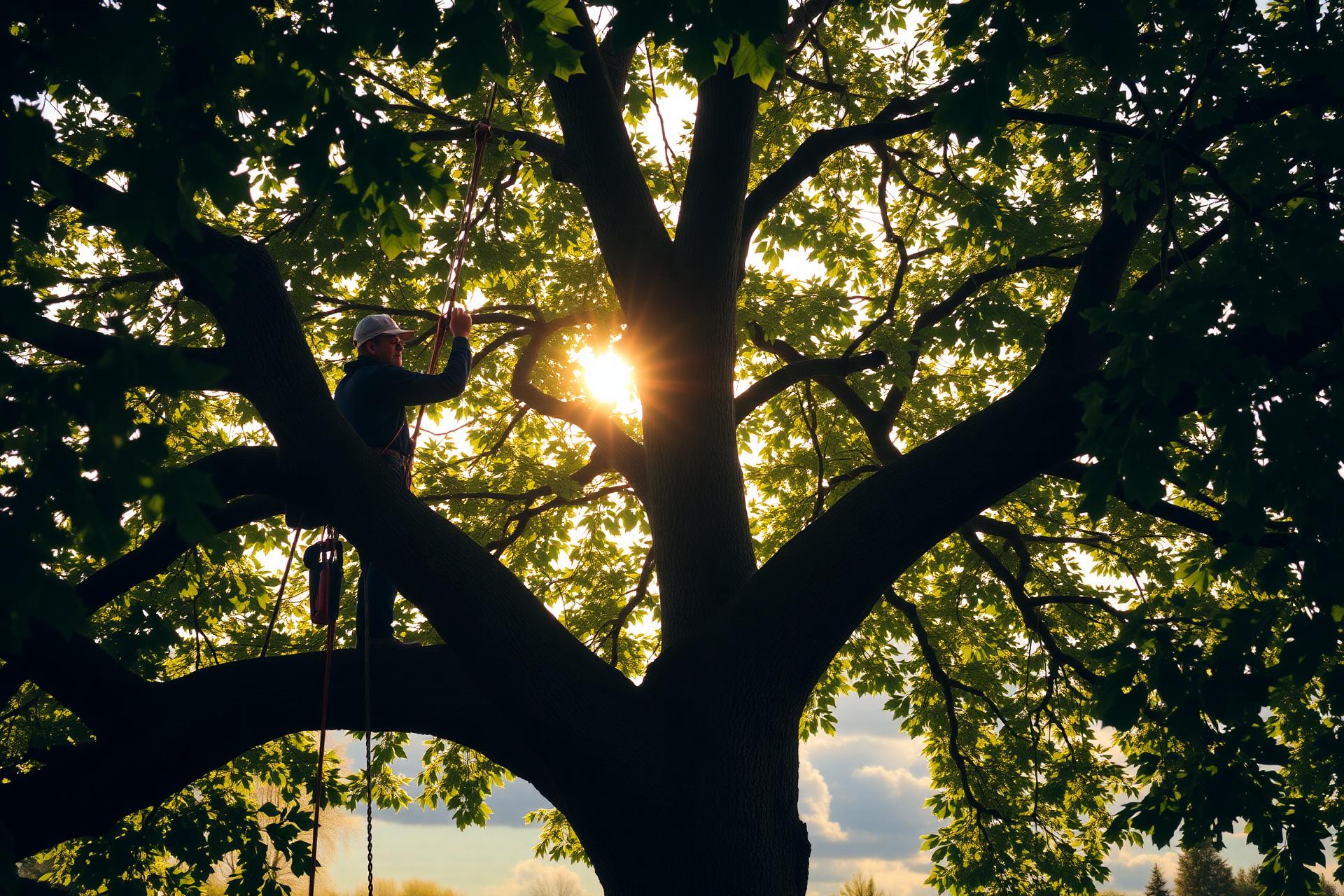
Crown Reduction for Walnut Trees
Juglans regia
Walnut is particular about when it is pruned. Get the timing right and it responds well.
Mature height
15–25m
Mature spread
10–15m
Best season
Summer or mid-winter
Avoid
Late winter and spring (sap bleed)
Why reduce a walnut
The case for reduction
Walnut trees develop substantial canopies that can dominate a garden. They also produce juglone, a chemical compound that suppresses the growth of many other plants beneath and around them, a practical reason beyond light blocking for wanting to manage the crown's extent. Established walnut trees in older gardens are a common source of crown reduction enquiries, particularly where the tree has grown to a size the original garden could not have anticipated.
Species profile
- Mature height
- 15–25m
- Mature spread
- 10–15m
- Growth rate
- Moderate
- Annual growth
- 20–40cm per year
- Lifespan
- 200–300 years
- Commonly found in
- Older established gardens, rural properties, larger suburban gardens
- TPO likelihood
- Moderate
- Clay planting distance
- 15m on high-shrinkage clay (NHBC Zone H)
How it responds
- Tolerance
- Moderate to good, Walnut responds adequately to reduction when the timing is correct. Large cuts should be minimised as walnut is slower to compartmentalise significant wounds than some other deciduous species.
- Regrowth vigour
- Moderate, Regrowth is steady. Follow-up work every 5–7 years is typical.
- Max reduction
- 20% per visit, Maximum 20–25% in a single visit. Conservative reductions tend to produce better long-term results with walnut.
When to do the work
Best season: Summer (June–August) or mid-winter (December–January). These two windows avoid the sap bleed period. Summer cuts, once leaves are fully open, heal well and avoid the peak sap pressure of spring. Mid-winter cuts, in the depths of dormancy before sap begins to rise, are also suitable.
Avoid: Late winter to spring, February through May. Walnut bleeds sap heavily if cut during the period of rising sap pressure before and during bud break. The bleed is not fatal to the tree but it is significant and entirely avoidable with correct timing. Walnut shares this characteristic with birch.
Nesting: Nest check required before any work between March and August.
Warning signs to look for
- • Canopy extending to shade areas of garden where other plants are failing, potentially compounded by juglone effects
- • Overhanging branches approaching boundaries or buildings
- • Dieback in the crown, walnut can be susceptible to honey fungus and should be assessed if dieback is apparent
- • A tree that has not been assessed for a decade or more
Disease & pest notes
Walnut leaf spot (Xanthomonas juglandis) causes dark spots on leaves and husks, cosmetically significant but not a structural threat. Honey fungus (Armillaria spp.) is a concern for walnut on some sites. Any walnut showing crown dieback or producing toadstools from the base should be assessed by an arborist before reduction is specified.
Aftercare
No wound sealant. Monitor cut points for callus development. Given walnut's slower wound closure compared to faster-healing species, keeping reduction percentages conservative and cuts to suitable laterals is important for minimising long-term decay risk.
Legal considerations
Walnut TPOs exist, particularly on older specimens in established gardens. Conservation area rules apply as standard.
Cost indicator
Moderate to high depending on size and access. The timing restriction (summer or mid-winter only) limits scheduling flexibility and may affect availability.
FAQs
Walnut reduction questions
Nothing grows well under my walnut tree. Is this normal?
Yes. Walnut roots and leaf litter produce juglone, a compound that inhibits the growth of many other plant species, a characteristic called allelopathy. Some plants are tolerant of juglone; many are not. This is a property of the species and is not affected by crown reduction, though reducing the canopy spread will shift the zone of effect.
Why can't my walnut be reduced in spring?
Walnut bleeds sap substantially during the period of rising sap pressure before and around bud break. Cuts made in February through April can produce significant sap flow. This does not kill the tree but it is avoidable, summer and mid-winter are the appropriate windows.
Will crown reduction affect nut production?
A moderate reduction, 20–25%, should not significantly affect nut production in the long term, as the tree re-establishes its fruiting wood within a growing season or two. Heavy-handed work, or work carried out at the wrong time, can set the tree back temporarily.
Other species
Browse more trees
Oak
Quercus robur
The most common large tree in English gardens. And one of the most commonly protected.
Sycamore
Acer pseudoplatanus
Fast, vigorous, and seemingly everywhere. Sycamore is the tree that never quite fits the space it's been given.
Common Lime
Tilia × europaea
The most forgiving tree to reduce. Also the one that grows back fastest.
Tree outgrown its setting? Let's reduce it properly.
Free no-obligation site visit, fixed quotes, UK-wide coverage.